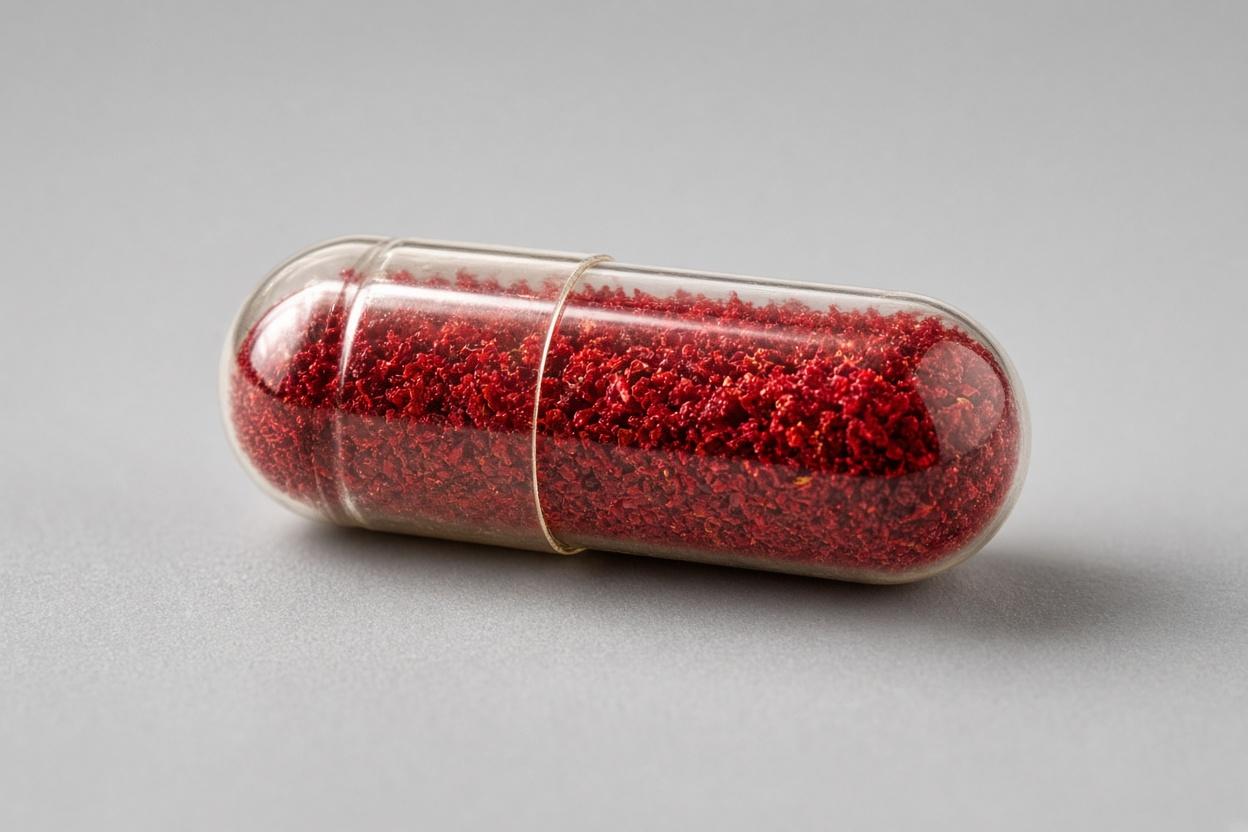
The Alzheimer trials used 30 milligrams a day of saffron extract, split as 15 milligrams twice a day. The lengths were 16 weeks, 22 weeks, and 12 months. The people enrolled had probable Alzheimer disease, mild cognitive impairment, or, in one trial, a recent heart bypass. They were not a general group of healthy adults reporting mental fatigue. The measures were the Alzheimer Disease Assessment Scale cognitive subscale, the clinical dementia rating, the mini-mental exam, and, after bypass, a Wechsler memory scale.
Placebo, mild to moderate
One 16-week trial reported better dementia scores than placebo.
Forty-six patients with probable mild to moderate Alzheimer disease were screened for a 16-week double-blind trial. They received 30 milligrams a day, as 15 milligrams twice a day, or placebo. After 16 weeks the paper reports a better outcome than placebo on the cognitive subscale (F = 4.12, P = 0.04) and on the clinical dementia rating (F = 4.12, P = 0.04). Adverse events did not clearly differ. The authors called saffron safe and effective in the short term. This page does not. One small trial is not a treatment, and a dementia scale is not an everyday focus test.
PubMed 20831681
Beside donepezil
Fifty-four adults, 22 weeks, and no proof the two are equal.
Fifty-four adults, 55 or older, with mild to moderate Alzheimer disease were eligible for a 22-week trial of 30 milligrams a day of saffron, again as 15 milligrams twice a day, or donepezil 10 milligrams a day. The authors said saffron was effective in a way similar to donepezil, and they called the evidence preliminary. A 2020 review of the score changes found no significant difference between the groups. Vomiting was more frequent on donepezil. A missing difference in a phase II trial is not proof the two are the same, and it is not a reason to stop donepezil. The paper lists support from Tehran University of Medical Sciences and from a company, Green Plants of Life.
PubMed 19838862 · PubMed 32445136
Beside memantine
Sixty-eight patients, a year, and again no clear gap.
Sixty-eight patients with moderate to severe Alzheimer disease, a mini-mental score of 8 to 14, received memantine 20 milligrams a day or saffron extract 30 milligrams a day for 12 months. The change in the severe cognitive impairment rating did not differ (P = 0.38), and neither did the functional staging score (P = 0.87). Adverse events did not clearly differ. The authors said the year of saffron looked comparable to memantine. Comparable, in a trial of this size, is not proof of equality, and it is not a reason to set memantine down. The authors asked for larger and longer confirmation.
PubMed 25163440
Mild cognitive impairment
A waiting list, not a placebo, and no reported dose in the review.
A single-blind trial followed people with amnestic multi-domain mild cognitive impairment for 12 months. The paper reports 17 people on saffron and 18 on a waiting list. It says mini-mental scores improved on saffron (P = 0.015) while the waiting-list group deteriorated. A 2020 review found no clear difference on the Montreal Cognitive Assessment (P = 0.62). That review could not list a dose for this trial. A waiting list does not show how much of the change was time and attention. This is not a result about ordinary focus.
PubMed 27472878 · PubMed 32445136
After heart surgery
The trial outside the dementia group did not find a difference.
People under 70, after on-pump coronary bypass, with a Wechsler memory score above 70, took 15 milligrams of saffron twice a day or placebo for 12 weeks. The paper reports no significant difference on the memory scale, the mini-mental exam, or the anxiety and depression subscales, and no significant time-by-treatment interaction. The authors said the results do not support a benefit for these bypass-related conditions. A 2020 review counted 55 people in this trial and treated it as the one study in people who were not enrolled for dementia or mild cognitive impairment.
PubMed 29185780 · PubMed 32445136
What is missing
Everyday attention and processing speed were not the tests.
This room did not find a set of randomized trials that measured attention tasks or processing speed in healthy adults and showed a clear benefit. A 2024 review of 46 mixed trials said saffron was more effective than placebo on cognition. The abstract prints numbers for depression, anxiety, and sleep, and it does not print a separate cognition figure. Those 46 trials were not all cognition trials. The authors used the word non-inferior for cognitive disorders. That is the authors speaking. It is not proof of equality. A separate 2024 review of four studies and 118 people looked at saffron in ADHD and called the results promising. That is a diagnosed attention disorder, a different question, and it is not a reason to change a prescribed stimulant.
PubMed 38424688 · PubMed 37864351